The People in the Middle: Why Your Loose Connections Might Be Your Greatest Community
There's a guy at your local coffee shop — you don't know his last name, but you know he takes his coffee black and always asks how your week's going. There's the woman from your Saturday pottery class who remembers that you were nervous the first time you tried to center clay. There's the coworker two floors up who you only really see at the printer, but somehow those two-minute conversations are the ones you think about on the drive home.
None of these people are in your phone under "favorites." You probably wouldn't call them in a crisis. And yet — they make your days feel more human. More connected. More like you're part of something.
That's not a small thing. That's actually everything.
What Sociologists Have Known for Decades (That We Keep Forgetting)
Back in 1973, sociologist Mark Granovetter published a now-famous paper called The Strength of Weak Ties. His central argument: the people on the edges of your social network — the acquaintances, the casual regulars, the friendly-but-not-close folks — are often more valuable than your closest relationships in specific, surprising ways.
His original research focused on job hunting (people were more likely to find employment through loose contacts than close friends), but the implications go much further than career networking. Weak ties expose us to new ideas, new perspectives, and new opportunities that our inner circles — precisely because they know us so well — often can't provide.
Close friends tend to move in the same circles you do. They share your references, your politics, your sense of humor. That's comforting. It's also a little bit of an echo chamber. Weak ties crack that chamber open.
The Pressure of the "Tight-Knit" Ideal
American culture has a strange obsession with the idea of the close-knit friend group. Think about how we consume TV: Friends, Insecure, New Girl, Abbott Elementary — the social ideal is almost always a defined, loyal cluster of people who show up for each other in big, dramatic, emotionally legible ways.
That's great television. It's also a setup for real-life disappointment.
For a lot of people — especially those who've moved cities, changed careers, gone through divorces, or simply aged out of the social structures that used to do the heavy lifting — that tight inner circle either doesn't exist or doesn't look the way they imagined it would. And because we've been told that's the gold standard of belonging, the absence of it can feel like personal failure.
But here's the thing: the pressure to have a ride-or-die squad can actually make us overlook the genuine warmth that's already surrounding us. We're so busy mourning the friends we think we should have that we miss the community we're already in.
What Loose Ties Actually Give You
Let's be specific, because this isn't just feel-good theory.
Weak ties provide what researchers sometimes call "ambient belonging" — a low-grade but persistent sense that you are known, recognized, and welcomed in the world. It's the neighbor who waves every morning. The barista who starts making your order when she sees you walk in. The guy in your running club who always high-fives you at the turnaround point even though you've never hung out outside of Tuesday mornings.
These micro-moments of recognition add up. Studies on loneliness suggest that the frequency of social interaction matters as much as its depth. In other words, seeing ten different people briefly across a week can do more for your mental health than one long, intense conversation with a best friend — especially if that best friend lives three time zones away and you're both too tired to schedule a call.
Loose ties also offer something close relationships sometimes can't: low stakes. You can be a slightly different version of yourself with your pottery classmate. You can share an opinion without worrying about how it lands in the context of a ten-year friendship. There's freedom in connection that doesn't carry the full weight of your history.
How to Actually Tend to the Middle Ground
If you want to lean into this, it doesn't require grand gestures. It requires consistency and a little intentionality.
Show up regularly to the same places. Weak ties form through repeated, low-pressure exposure. The gym, the farmers market, the neighborhood coffee shop, the community garden — these are the kinds of places where casual connection accumulates naturally over time. You don't have to be charming or memorable. You just have to keep showing up.
Learn a few things and remember them. You don't need to know someone's whole life story to make them feel seen. Remembering that your coworker just adopted a dog, or that your neighbor is training for a half-marathon, goes a long way. Small acts of recall signal that someone registers as a real person to you — not just background noise.
Let conversations be what they are. Not every good exchange needs to become a friendship. There's a particular kind of pressure we put on nice interactions — the impulse to exchange numbers, to make plans, to escalate. Sometimes the best thing you can do is enjoy a good ten-minute conversation and let it be exactly that. The value was in the moment.
Invest in community infrastructure. Join the neighborhood association. Volunteer at the school fundraiser. Go to the block party even if you only know two people. These aren't just civic duties — they're the environments where loose ties are made and maintained. They're the architecture of belonging.
Gathering Without the Grand Friendship
The name Tsudoi means gathering — a coming together of people in the same space, for the same moment. And what strikes me about that concept is that it doesn't require intimacy as a prerequisite. A gathering is open. It makes room for the person you've known for years and the person you're meeting for the first time.
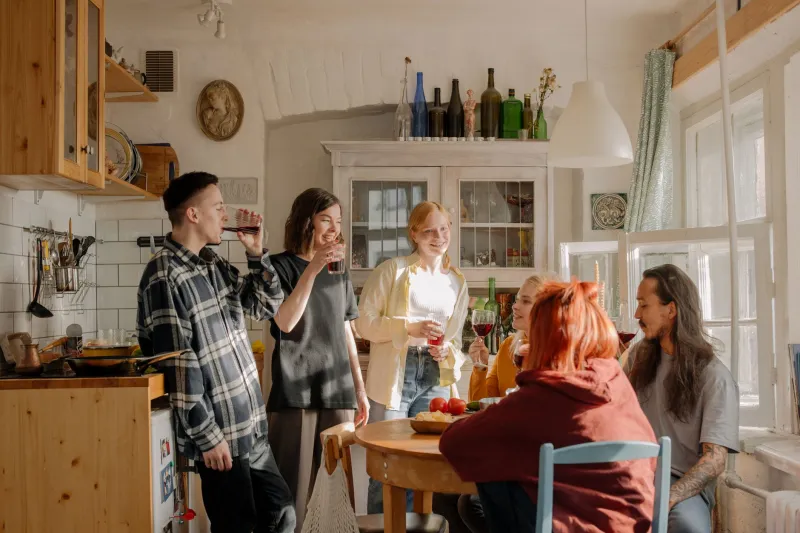
Some of the most alive spaces are the ones where both kinds of people coexist. The dinner party where your close friend brings a coworker you've never met. The community run where regulars and newcomers mix at the water station. The backyard barbecue where someone's cousin ends up being the most interesting conversation you've had all summer.
This is what loose ties look like in practice. Not a replacement for deep friendship, but a different kind of richness — one that keeps you porous to the world, open to surprise, and quietly reminded that you are part of something bigger than your inner circle.
You don't have to know someone well to matter to them. And they don't have to know you well to matter to you. That's not a consolation prize. That's community, doing exactly what it's supposed to do.