Set a Place for the Grief: What Happens When You Stop Pretending You're Fine at the Table
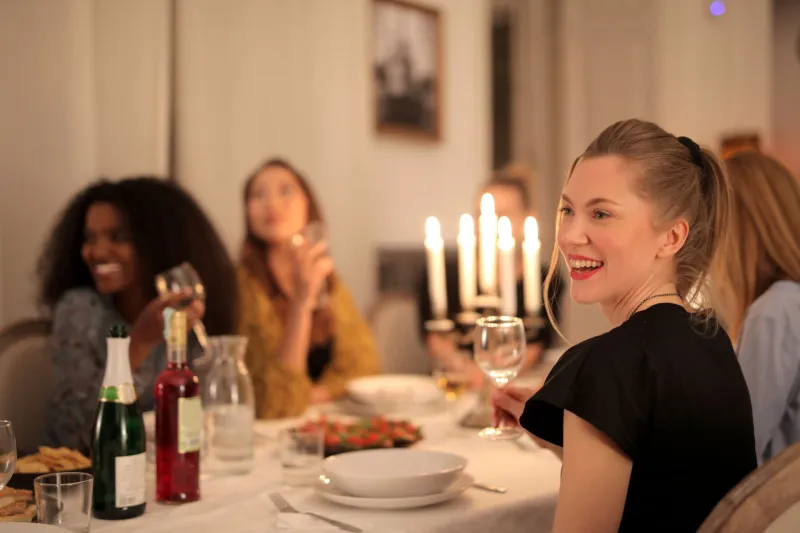
There's a particular kind of exhaustion that comes from showing up somewhere — a dinner party, a Sunday brunch, your cousin's birthday thing — and spending the whole night pretending you're not carrying something heavy. You pass the bread. You laugh at the right moments. You say "I'm doing okay, just busy" approximately eleven times. And then you drive home alone and feel somehow emptier than when you arrived.
We've all done it. And most of us have hosted for people doing the exact same thing at our tables.
What if we've been getting this wrong?
The Performance of Fine
American social culture has a complicated relationship with sadness. We're pretty good at crisis — casseroles show up, people rally, there are cards. But grief that lingers? Loss that doesn't resolve neatly? That's where things get awkward. We don't have a great script for it, so we default to performing normalcy and hoping nobody brings it up.
The problem is that this performance costs something. It costs the person carrying the loss — who has to burn energy they don't have just to seem acceptable. And it costs the room, too, which ends up feeling slightly hollow because something real is being kept just outside the door.
Gathering spaces — dinner tables, living rooms, the corner booth at your regular coffee spot — have the potential to be genuinely sacred. But they only get there when people are actually present. And you can't be fully present when half of you is managing a performance.
What Acknowledgment Actually Does
There's a difference between making grief the centerpiece and simply letting it exist in the room. Nobody is suggesting you turn every get-together into a group therapy session. But there's enormous space between "we never mention it" and "we talk about nothing else."
When someone walks into a gathering and the host says, quietly and without making it a whole thing, "I'm really glad you came. I know this stretch has been hard" — something shifts. The person doesn't have to pretend anymore. They can just be there. And being there, actually there, is where connection happens.
Research on social support consistently shows that acknowledgment — even brief, even imperfect — is more meaningful than distraction. People don't need others to fix their grief. They need to feel like their grief doesn't make them untouchable. When a gathering space signals that your whole self is welcome, including the parts that are sad or scared or still processing something from six months ago, the room becomes something different. It becomes somewhere you actually want to be.
Hosting After Loss: The Unexpected Threshold
If you've ever lost someone and then found yourself hosting — maybe because the holiday was already planned, maybe because canceling felt like too much, maybe because some instinct told you that filling your house with people was the only thing that sounded bearable — you know that it can go one of two ways.
It can feel like you're running a show while your heart is somewhere else entirely. Or it can become one of the most unexpectedly healing things you've ever done.
The difference, almost always, is whether you let the loss be part of the evening. Not in a heavy, grief-soaked way. But in the way that you mention the person who isn't there. You set out something that belonged to them, or you make the dish they always requested, or you just say at some point: "I miss her. I'm really glad you're all here."
That small act of naming it changes the whole texture of the night. Suddenly your guests aren't tiptoeing around an elephant. They're actually with you. And you're not performing a version of yourself that doesn't exist right now — you're just a person who is hurting and also grateful and also making dinner, which is the most human combination of things imaginable.
When You're the Guest
This works the other way, too. Showing up to someone else's gathering when you're in the middle of something hard — a divorce, a diagnosis, a loss that hasn't gotten easier yet — can feel like an act of pure survival. You go because staying home alone seemed worse. You go because someone invited you and it seemed like a sign.
And then you get there and you're not sure how much to say or whether to say anything at all.
Here's the thing: you don't owe anyone a full accounting of your inner life. But you also don't have to be a sealed box. There's something in between — the honest answer when someone asks how you're doing, the brief mention that things have been a lot lately, the willingness to receive care when it's offered instead of deflecting it with a joke.
When you let people in, even a little, you give them the chance to actually show up for you. And more often than not, they will. People want to be useful to each other. They want to matter. Your honesty gives them somewhere to put that impulse.
The Table as Witness
There's a reason so many cultures center their most important rituals — mourning, celebrating, marking transitions — around food and gathering. The table has always been where humans process the big stuff together. A meal shared after a funeral isn't just logistics. It's the community saying: we will keep eating, keep talking, keep showing up, and we will do it with you.
Somewhere along the way, modern American entertaining started to feel more like a production than a ritual. We worry about whether the house is clean enough, whether the food is impressive enough, whether we seem put-together enough. And in all that worrying, we lose the actual point.
The actual point is presence. Real presence — not the curated kind.
A gathering becomes sacred not because everything went perfectly, but because something true happened there. Because someone said the hard thing. Because the grief was named instead of avoided. Because people left feeling less alone than when they arrived.
Letting the Whole Thing In
You don't have to engineer a meaningful gathering. You don't have to orchestrate the moment where everyone gets vulnerable and the music swells. You just have to be willing to stop pretending — and to make it clear, in whatever small way feels right, that others don't have to pretend either.
Grief is going to show up anyway. It always does. It comes in the door with your guests whether you invite it or not. The only question is whether you're going to acknowledge it or spend the whole night pretending it's not standing in the corner.
Set a place for it. Let it sit down. Then pass the bread and keep going.
That's where the real gathering begins.