Screens Can Hold Space Too: How to Make Online Gathering Actually Feel Like Something
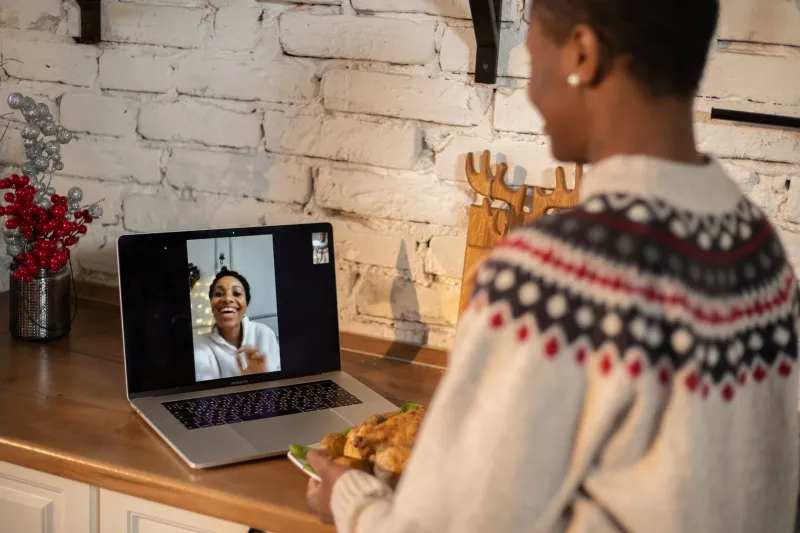
Let's be honest about something: most of us have sat through a video call that felt like a performance review of our own social lives. Everybody staring slightly off-center into their cameras, someone's audio cutting out mid-sentence, a long pause where nobody's quite sure whose turn it is to talk. You hang up and feel somehow lonelier than before you logged on.
But here's the thing — that hollow feeling isn't proof that digital connection is fake. It's proof that we haven't figured out how to do it with intention yet.
The principles that make an in-person gathering feel alive — ritual, presence, a sense of welcome — don't disappear just because everyone's in a different zip code. They just need to be translated. And that translation? It's actually worth the effort.
Why Online Gathering Keeps Falling Flat
When we gather in person, there's a whole invisible architecture holding the experience together. The smell of food. The act of crossing someone's threshold. The ambient noise of a room. These sensory cues signal to your nervous system: you are somewhere. You belong here right now.
Strip all of that away and suddenly you're responsible for generating all that warmth yourself — from scratch, through a camera lens, while also wondering if your lighting makes you look tired.
Most virtual hangouts fail not because people don't care, but because nobody took the time to think about what the experience should feel like. We default to the format of a work meeting — a grid of faces, an implicit agenda, someone screen-sharing a thing — and then wonder why it doesn't feel like a Saturday afternoon at a friend's kitchen table.
The fix isn't better Wi-Fi. It's better design.
Start With a Ritual, Not an Agenda
One of the simplest things you can do to shift the energy of a virtual gathering is to open with something that isn't business. Not "okay, so why don't we go around and share updates" — something smaller and stranger and more human.
Maybe it's a standing question your group answers every time you meet. What's one thing you ate this week that was genuinely good? What's been living in your head lately? Show us something in your house that's been making you happy. These aren't icebreakers in the corporate sense — they're tiny rituals that signal: this space is different from your inbox. We're here for each other.
Communities that gather online with real staying power almost always have some version of this. A book club that opens with everyone sharing what they're currently reading beyond the assigned book. A friend group that always starts their Sunday video call with coffee visible on camera, no excuses. A Discord server with a dedicated channel just for sharing photos of whatever's outside your window that day.
The ritual doesn't have to be elaborate. It just has to be yours.
Give the Space a Shape
Physical gatherings have a natural arc — arrival, the slow warm-up, the peak energy, the wind-down, the goodbye at the door. Online spaces tend to start abruptly and end even more abruptly (someone says "okay I should probably let you go" and then everyone disappears in three seconds).
Building a gentle shape into your virtual time together makes a real difference. A soft opening where people trickle in and chat before anything "starts." A clear moment where the main thing — the watch party, the group dinner, the conversation — begins. And an intentional close, something more than just everyone hitting "leave."
Some groups have started doing what you might call a send-off — a last two minutes where everyone shares one word for how they're leaving the call, or a standing joke that only makes sense to that group, or even just a sincere "I'm really glad we did this." It sounds small. It lands bigger than you'd expect.
The Group Chat Is Underrated
Not everything has to be a scheduled video call. Some of the most consistent community happens in the in-between — the group text that's been going for four years, the Discord server where people drop in and out all day, the shared playlist that everyone keeps adding to.
These low-stakes, asynchronous spaces do something that synchronous calls can't always manage: they let people show up in small ways, on their own time, without the pressure of performing presence on camera. A funny screenshot. A question that's been bugging you. A photo of the sunset you almost didn't stop to take.
Over time, these small deposits build something real. A rhythm. A shared language. A sense that even when you're going about your completely separate lives, there are people tracking alongside you.
If your digital community only exists during scheduled calls, it's going to feel more like an appointment than a relationship. The group chat is the connective tissue.
When the Screen Is Actually the Right Choice
There's a version of this conversation that treats digital connection as a consolation prize — something you do when you can't have the "real thing." But that framing misses something.
For a lot of people — those with chronic illness, social anxiety, geographic isolation, demanding caregiving schedules — the screen isn't a lesser option. It's the option that actually makes community possible. A virtual book club might be the only consistent social touchpoint someone has that isn't work or family. A group chat might be the place where a person gets to be fully themselves in a way they can't manage in physical spaces.
Choosing the screen isn't giving up. Sometimes it's the most honest and sustainable way to keep showing up for the people who matter to you.
The goal was never the format. It was always the feeling — that someone is glad you're there, that you're known, that the space held something worth returning to.
You can build that through a camera. You can build that in a group chat. You can build it anywhere, really, as long as you're willing to design it like it matters.
Because it does.